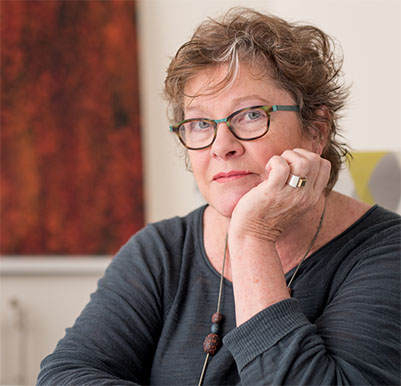
About Susan Eriksson
Susan Eriksson is a painter, metalsmith, and geoscientist known for her mixed-media sculptures which interweave both artistic and scientific languages. Eriksson conducted mineralogical research in pursuit of her Masters degree from Stony Brook University which evolved into completing her her PhD in Geology at the University of the Witwatersrand in South Africa. While on a research leave in Australia, she began an independent apprenticeship in metal-smithing which she continued for the next decade following her return to the U.S.
The subject matter of Eriksson’s earth-based sculptures derives heavily from her career in geological research and education which has led her to study in South Africa, Zimbawe, and Australia. During 22-years as a faculty member of Virginia Tech, Eriksson was also curator of gemstones and minerals, a role in which she interpreted the significance of these natural objects as well as contemplated their innate beauty. Influenced extensively by the experiences she has had as a scientist, her artwork is imbued with a visual vocabulary and conceptual impetus gleaned from geology. In her sculptures she intermixes metal, wood, and other natural materials with sedimentary bands and layers of paint. Intuitive and poetic in their handmade construction, the works also include deeply embedded metaphors symbolizing the processes and history of the earth.
Susan Eriksson’s work has been shown nationally in galleries and institutions with her most prominent solo exhibitions, Written in Stone, held in 2009 at the National Science Foundation in Arlington, Virginia and Earth Science Messages, held in 2008 at American Association for the Advancement of Science in Washington D.C. She currently lives and works in Singapore.
More...Artist's Statement
Geology provides the visual vocabulary and conceptual impetus for my work. I create objects with complex, layered compositions from diverse natural materials in order to investigate themes of time and place, fragmentation versus wholeness, and the construction of knowledge.
I support the underlying assumption that a person never knows the whole ‘truth’, nor is one able to see all aspects of an inquiry. I acknowledge that one brings prior knowledge and experience to everything one finds/sees/investigates/thinks about, processing small bits of information internally until deciding what one ‘knows’ or ‘believes’ to be true. The field of education calls this constructivism; scientists call it a post-modern theory of science and a rejection of positivism. In my work, I use geology as a metaphor for this process of knowledge construction. Geoscientists obtain a piece of rock, a core, or a bit of chemical or geophysical data and then put these pieces together to reconstruct Earth’s processes and history.